
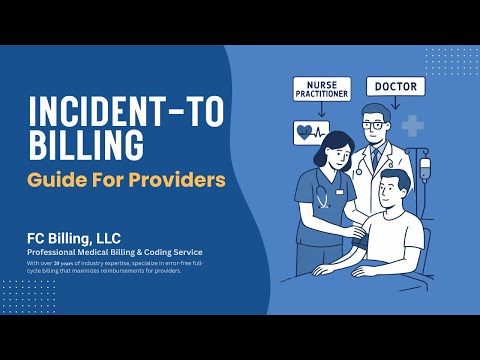
Incident-to billing is a Medicare billing provision that allows non-physician practitioners (NPPs), such as Nurse Practitioners (NPs), Physician Assistants (PAs), clinical nurse specialists, and others, to bill under a supervising physician’s National Provider Identifier (NPI) number.
This allows the claim to be reimbursed at 100% of the physician fee schedule, instead of the 85% NPP rate. But to qualify, strict guidelines must be followed.
Used strategically, incident-to billing can significantly boost your practice’s revenue. Yet, many providers unintentionally lose income each month due to errors or missed opportunities in applying this rule.
Why Incident-to Billing Matters
Incident-to billing is designed to save costs and improve patient access while ensuring oversight by physicians. It:
- Maximizes Medicare reimbursement for services provided by NPPs.
- Expands provider productivity without sacrificing revenue.
- Keeps physician time focused on complex cases, while routine visits are handled by qualified staff.
However, Medicare and other payers have strict compliance rules surrounding it.
Who Can Bill Incident-to?
To qualify for incident-to billing, the following types of staff can provide services:
- Nurse Practitioners (NPs)
- Physician Assistants (PAs)
- Certified Nurse Midwives
- Clinical Nurse Specialists
- Clinical Psychologists
- Other auxiliary personnel (e.g., registered nurses under supervision)
However, services must be billed under a physician’s NPI, and not all payers follow the same rules; more on that below.
Where Can Incident-to Billing Be Used?
Incident-to billing is allowed only in physician office settings (Place of Service 11). It is strictly limited to services performed under the direct supervision of a physician within that office setting.
| Setting | Incident-to Allowed? |
| Physician’s Office | ✅ Yes |
| Outpatient Hospital Clinic | ❌ No |
| Inpatient Hospital | ❌ No |
| Skilled Nursing Facility | ❌ No |
| Home Visits | ❌ No |

Keep in mind: Medicare Advantage, Medicaid, and commercial payers may have different policies. Always check payer-specific rules before applying incident-to billing.
Core Requirements for Incident-to Billing
To bill incident-to successfully, every box must be checked:
- The physician performs the initial evaluation, diagnosis, and treatment plan.
- All follow-up care by NPPs must exactly follow the physician’s plan of care.
- The supervising physician is present in the office suite (not just reachable by phone) when the incident-to service is rendered.
- Services must be medically necessary and part of typical outpatient care.
- The physician must continue to be actively involved in the patient’s course of treatment.
Recent Update (2025): CMS now allows some incident-to supervision via telehealth in specific scenarios. The physician must be available virtually (like video call), not just by phone, if the NPP is employed and the service has the correct billing indicator. Always confirm current CMS and payer guidance for these scenarios
Incident-to Billing: What’s Not Allowed
Not all services qualify for incident-to billing. Medicare restricts its use to specific scenarios. Here’s what doesn’t count under the incident-to rules:
- Initial visits or first-time consultations by an NPP for a new patient.
- Services for a new problem or diagnosis, even with an existing patient.
- Hospital, nursing facility, or other institutional settings.
- Supervising physician not present in the office suite (unless specific telehealth remote rules are met).
- NPPs who are not credentialed with Medicare.
- Services already covered by other benefit categories (flu shots, diagnostic tests).

Incident-to Billing Compliance Table
Use this table to quickly determine when incident-to billing is allowed. It outlines common scenarios, eligibility, and key compliance rules based on Medicare guidelines.
| Scenario | Can Bill Incident-to? | Why / Why Not |
| NP sees established patient for follow-up | Yes | The physician made a plan, NP follows it |
| NP sees a new patient for the first visit | No | The physician must conduct an initial visit |
| NP sees the patient for a new medical problem | No | The physician must evaluate and create a plan |
| Physician not on-site during NP visit | No | The physician must be present in the office suite |
| Service delivered in a hospital setting | No | Office/clinic setting only |
| Follow-up by NP, physician on video call | Sometimes (2025) | Only if remote oversight is allowed by CMS |
Incident-to Billing Workflow: Step by Step
Follow these step-by-step guidelines to correctly implement incident-to billing, ensuring the physician’s involvement, proper documentation, and compliant claim submission.
- The physician examines the patient, diagnoses the problem, and establishes a written treatment plan.
- The plan is documented in the patient’s medical record, with clear instructions.
- NPP provides follow-up care, strictly following the physician’s plan.
- The physician is present in the office suite (same site) whenever the NPP sees the patient.
- If a patient presents with a new complaint, NPP refers to the physician for a new E/M; the process restarts.
- Claims are billed under the physician’s NPI, not the NPP’s, when all criteria are met.
- Maintain clear documentation for every step and visit.

Documentation Tips for Incident-to Billing
Compliance and audit-readiness depend on strong documentation. Your records must show:
- The physician conducted the initial visit and created the treatment plan.
- The NPP followed the established plan for all billed visits.
- The supervising physician was present at the site (or, when allowed, available by telehealth).
- Any change in diagnosis or treatment resulted in a new physician visit.
- Signatures from both providers, when required.
Personal Tip: Use EHR templates with built-in incident-to compliance prompts. This reduces missed steps and strengthens your audit defense.
Incident-to Billing vs. Direct Billing
Proper billing depends on who provided the service and under what conditions. Below is a table to decide between incident-to billing or billing directly under the NPP’s NPI to stay compliant.
| Category | Incident-to | Direct Billing (NPP’s NPI) |
| Who gets paid | Supervising physician (NPI) | NPP (NPI) |
| Reimbursement rate | 100% of the physician fee schedule | 85% of physicians rate (Medicare) |
| When to use | For follow-ups, per the plan, all rules | When the rules are not met, new problems |
| Signature requirements | Physician or NPP (documented plan) | NPP bills and signs |
Key Point: Bill directs under the NPP’s own NPI when the visit does not meet every incident-to requirement. Don’t risk denials or compliance exposure by forcing an incident-to claim.
Common Mistakes in Incident-to Billing & How to Avoid Them
Identify typical incident-to billing mistakes and follow best practices to avoid denials and compliance risks:
- Billing new patients as an incident-to—always start with the physician.
- Billing new problems without physician input—get physicians involved and document plans.
- Physician not immediately available—don’t bill incident-to if not on-site (unless virtual supervision meets CMS’s current criteria).
- Not updating the treatment plan after a significant change, the physician must reassess.
- Forgetting to track which doctor is supervising on-site—use sign-in sheets or EHR attendance logs.
Current Trends and Compliance Risks
Medicare and the OIG are focusing on incident-to billing in audits due to frequent misuse. Failing to follow the rules can lead to claim denials, repayments, or even legal penalties. Commercial insurers may have different or more restrictive rules than Medicare. Always check each payer’s handbook, as not every insurer allows incident-to billing.

Conclusion
Incident-to billing is a valuable way to increase your practice’s revenue by allowing services provided by non-physician practitioners to be billed under a supervising physician’s NPI at full physician rates. However, it requires careful adherence to strict rules, such as physician involvement, location, patient status, and documentation, to maintain compliance and avoid costly denials or audits.
Remember that incident-to billing applies only to established patients, follow-up visits, and services performed in the physician’s office setting under direct supervision. New patients, new problems, or services delivered outside the office do not qualify.


